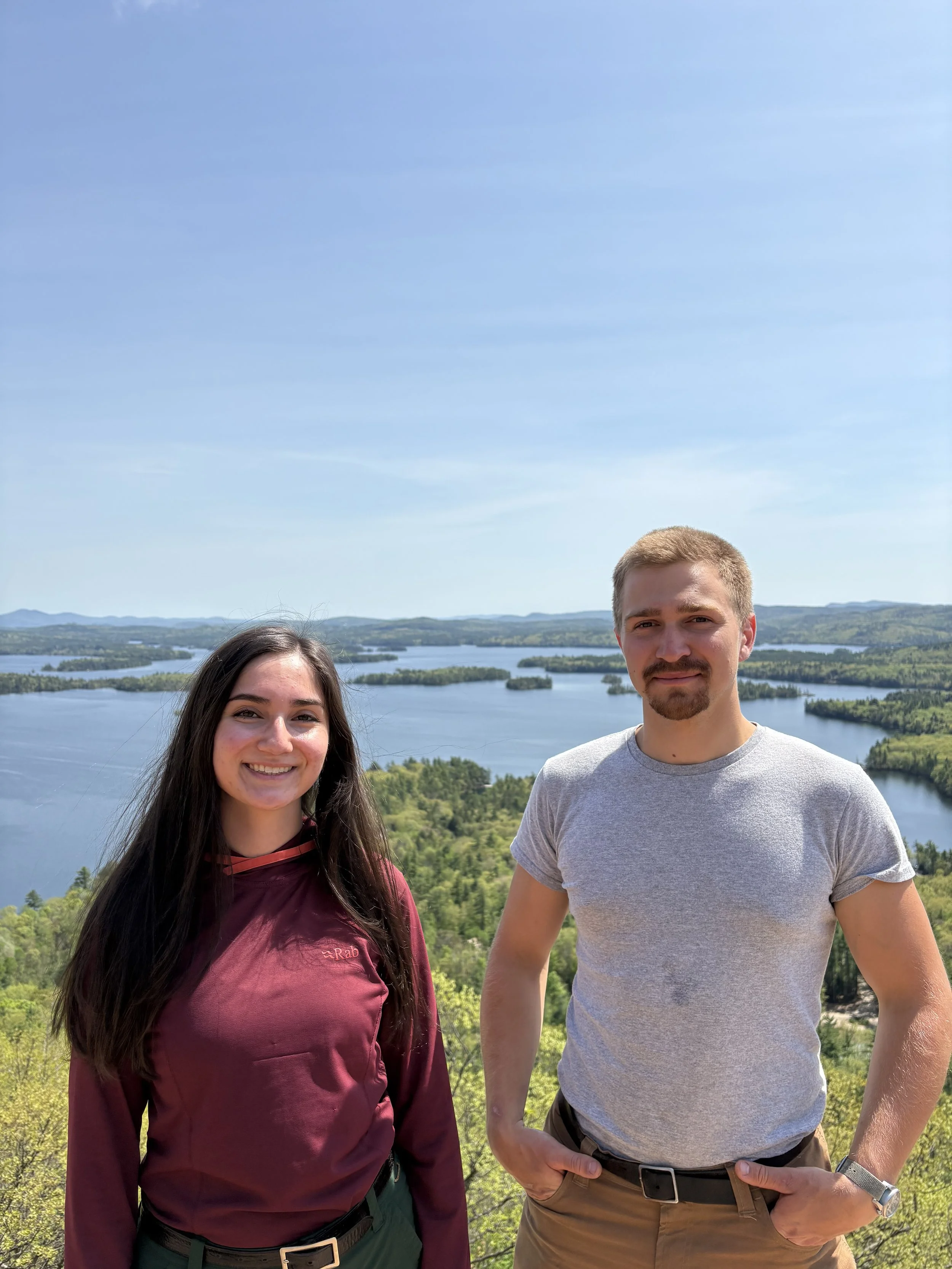
Olivia Jakabosky & Harper Walker-West. | Anna Paddock
We are delighted to welcome these two kind, skilled people to the Chocorua Lake Basin this season. Learn more about them below.
Olivia at Colombia's Chingaza National Park, an incredible landscape dotted with glacial lakes and home to the unique Páramo ecosystem. “While I don't have a single favorite habitat,” Olivia says, “I am especially drawn to landscapes with water.”
Olivia Jakabosky
What draws you to this place and this experience? What do you hope to learn?
I completed an AmeriCorps term of service during my undergraduate in Montana. I appreciated how the program not only introduced me to land trust work, but also facilitated mindful and meaningful engagement with the community and landscape. Through immersing me in the community through service, AmeriCorps helped me develop a deeper understanding of both the landscape and people by actively being a part of it. I have long admired and been drawn to the New England region for its historically layered landscapes, close-knit communities, strong sense of place, and the seasonality that shapes how people interact with the land around them. I applied for this AmeriCorps position so that I may learn through service and contribute thoughtfully to the surrounding community in a region I have long hoped to work and live in. I am also excited to develop deep place-based knowledge of Chocorua and increase my skills and understanding of land trust work, particularly within the context of the Northeast, as I pursue a land trust career in New Hampshire and the broader New England region. After spending the last six years immersed in research, I realized I feel most at home in the land trust space, where the work is both seamlessly interdisciplinary and community-oriented. I am particularly drawn to CLC's smaller land trust scale, which I believe fosters deeper, more meaningful relationships and engagement with the community. Additionally, a central passion that guides me is connecting people and nature, a value I see reflected and shared in CLC's mission and work.
What are some of the places on this planet that have informed your relationship to the other-than-human world? What have those places taught you?
During my education, I was active in research at the intersection of the ecological and social sciences (e.g. human dimensions of conservation, human-wildlife coexistence, community-based conservation, and anthropogenic effects on landscapes/wildlife/nature). This focus brought me to serve, research, and study across many regions including the US (Montana and Arizona), Latin America (Paraguay), East Africa (Kenya), and the United Kingdom (Cornwall). These places, so widely different from each other, taught me how nuanced and context dependent nature/ecosystems/communities are, and that to notice the similarities and differences, you need to listen first. These experiences provided me with a conservation toolkit of global approaches and, most importantly, it helped me build the cultural humility needed to serve diverse communities. If there is one main takeaway, these places have taught me to listen first and listen always to the people, the wildlife, the land, and the water.
What else do you like to do for fun? Secret art projects, hobbies, enjoyments?
Everywhere I've lived, I have made it an effort to step outside my comfort zones and pick up a new hobby. In England, I took up boxing; in Montana, I learned to fly fish; and in Arizona, I unlocked how to play Dungeons and Dragons. I enjoy learning new languages, such as Spanish and, more recently, Tagalog, the native language of my grandparents. I really enjoy social dancing and have picked up salsa, country swing, ballroom, and Irish céilí dancing through the places I have lived and traveled. As for the creative space, I am an acrylic painter, violinist, and I love to read anything related to nature, history, fantasy, and the classics. Of course, any outdoor activity makes me happy (hiking, birding, backpacking/camping, kayaking). I am excited to pick up a new hobby in Tamworth and excited for what it might be!
Where have you found inspiration recently?
I saw cherry blossoms blooming in Washington, DC for the first time this spring. It was an experience that felt quintessentially and beautifully human—so many people gathered in one place to witness something together within a fleeting moment (the blooms last just a few days!). It had me reflecting on the seasons and the importance of celebrating and embracing seasonality. I understand that the existence of four seasons varies across regions. However, there are small nuances that we can see, feel, and hear in the world around us, regardless of region, that quietly signal to us when the time has come for the seasons to change. It is those small moments in between seasons that I find the most special. I experienced a similar feeling witnessing so many people, who had traveled across the country and world, collectively gazing upon the blooming cherry trees who quietly and humbly call for our attention for but a brief moment in time. It is something I would recommend to anyone who has not yet seen them. However when the bloom arrives, similar to the transition of seasons, you have to wait and listen for it, and be ready to drop everything when it arrives.
Olivia’s Bio:
Olivia brings a globally informed background in research, community-based conservation, and land trust work. She earned a BS in Conservation Biology and Ecology, with minors in Sociology & Global Studies, from Montana State University, where she was first introduced to land trusts and inspired by their role in connecting people and nature. Most recently, as a US-UK Fulbright Scholar, Olivia completed her MS in Conservation and Biodiversity from the University of Exeter in England. Since returning to the U.S., she is excited to pursue a land trust career in New England, a region she has long been inspired by. Olivia is an enthusiastic hobbyist. When she's not adding a new hobby to her list, she can be found spending time outdoors, playing her violin, painting, learning a new social dance, or reading.
Harper Walker-West
Harper beside the mighty Mississippi, another watery landscape.
What draws you to this place and this experience? What do you hope to learn?
I left New England after high school because, simply put, it was time. I have now lived outside of the region for nearly five years and each year my yearning to come back has grown greater‚ there really is no place like home. I found CLC after seeing a job posting for a different Lakes Region Conservation Corps position. The more I looked into CLC, the better it sounded: a small group of people with passionate members caring for one watershed. During my time in school, I came to think that watersheds are one of the few lines we draw on maps that make any sense ecologically. I have never worked with a land trust before, but, like watersheds, they make a lot of sense to me. I hope to learn the ins and outs of being part of a land trust.
What are some of the places on this planet that have informed your relationship to the other-than-human world? What have those places taught you?
I grew up in rural Western Massachusetts and spent much of my childhood outside—both in town and in the woods. It was there that my relationship with the forest, and greater outdoors, first took shape. One thing that has always stuck with me was the broad range of perspectives that one finds there, as here in NH, regarding the land. Spending time both in town and in the woods helped me see the nuance that exists in their interface, an interface that is not always self-evident in rural areas.
Where have you found inspiration recently?
I am currently reading Gordon G. Whitney’s From Coastal Wilderness to Fruited Plain: A History of Environmental Change in Temperate North America from 1500 to the Present. This book has answered more questions than any other piece of literature thus far. For example, it has helped me understand better how glaciers interacted with the landscape and how far “up-ice” the deposits we see came from. For anyone who has read Changes in the Land: Indians, Colonists, and the Ecology of New England by William Cronon (and if you haven’t, I recommend it), I would consider this its more comprehensive sibling. Cronon’s book gives one of the most succinct accounts of New England’s landscape through a historical ecology lens.
Harper’s Bio:
Harper Walker-West
Though born and raised in Western Massachusetts, Harper has lived, worked, and studied in a few different places in the U.S. and abroad. Although he has found lots to love in all these places, it has become clear that rural New England is where he is supposed to be. Apart from this spatial clarity, his work and other experiences have made him think that land trusts represent the best form of land management organization, particularly in New England. CLC will be the first time that he works with a land trust, so he is very excited to begin. Harper holds a B.S. degree in Forestry with a specialization in forest hydrology. He enjoys reading, writing, playing music, hiking, biking, skiing, and a few other sports.