By Olivia Jakabosky
Earlier in the summer I was at the Island spreading woodchips after some heavy rains. I wandered down to the shoreline for a quick break and sat on a nearby stone. The lake was serene as the mist hugged the lake and low clouds flowed over the Sandwich range. As I sat there, Route 16 had finally fallen silent and in the distance I noticed a dark shape rise above the still water in the distance. Then I heard a call that felt otherworldly, haunting, and lonely. However, moments later, I saw another shape rise above the surface and realized that I had just seen my first pair of loons.
Prior to coming to New Hampshire, I had never seen a loon. Yet when I heard their call, it was strangely familiar somehow. Despite never hearing it in the wild before, it carried a deep sense of nostalgia for me, like if the wilderness could have a song.
From that day on, I found myself watching the pair quite regularly whenever I was at Chocorua Lake as they would go about their lives as I went about mine. When I learned that they were the only pair of breeding loons on the lake this year, it made every sighting feel special.
Feeding their chick on the lake last summer. | Debra Marnich
The more I learned about loons, the more I realized how precarious their lives really are. According to the Loon Preservation Committee, their most common threats come from ingesting lead fishing tackle, shoreline development, climate change, fluctuating water levels, entanglement in fishing line, contaminants, human recreation, and predators. Even under ideal conditions, a pair lays only one or two eggs each season. While loons may attempt to renest up to three times after a failed nesting attempt, they can only raise one brood in a season if their eggs hatch successfully.
When I learned that the Chocorua pair had lost their eggs to a bobcat, I expected to find a quiet and empty lake. I assumed the loons would have been spooked and moved on to another lake. Instead, I heard that call once again on the lake and noticed the two loons continuing with their daily routines. They had endured a loss that would end their breeding season, but I thought then that nature often teaches us lessons without words.
For me, the loons have now come to represent more than the ethereal call that first captured my attention. Loons are often associated with Northern New England–printed on postcards, shirts, and logos. However, I think they are more than just the poster child of northern lakes; they teach us the strength of quiet resiliency where we continue onward despite uncertainty and struggle.
Loons, like most things, are not invincible. They are a highly vulnerable species due to factors beyond their control, yet they continue to move across the water together, facing new challenges every year. I haven’t seen them in some time and perhaps they moved on elsewhere, but when I think back to them, it reminds me we have plenty to learn from nature, every day.
Olivia Jakabosky is CLC’s 2026 Land Steward through the Lakes Region Conservation Corps. Olivia has a B.S. degree in Conservation Biology and Ecology, with minors in Sociology & Global Studies from Montana State University, and an M.S. degree in Conservation and Biodiversity from the University of Exeter in England. This is Olivia’s first time living in New England, and she has quickly come to love the diverse insects, wildlife, and plants of this region.
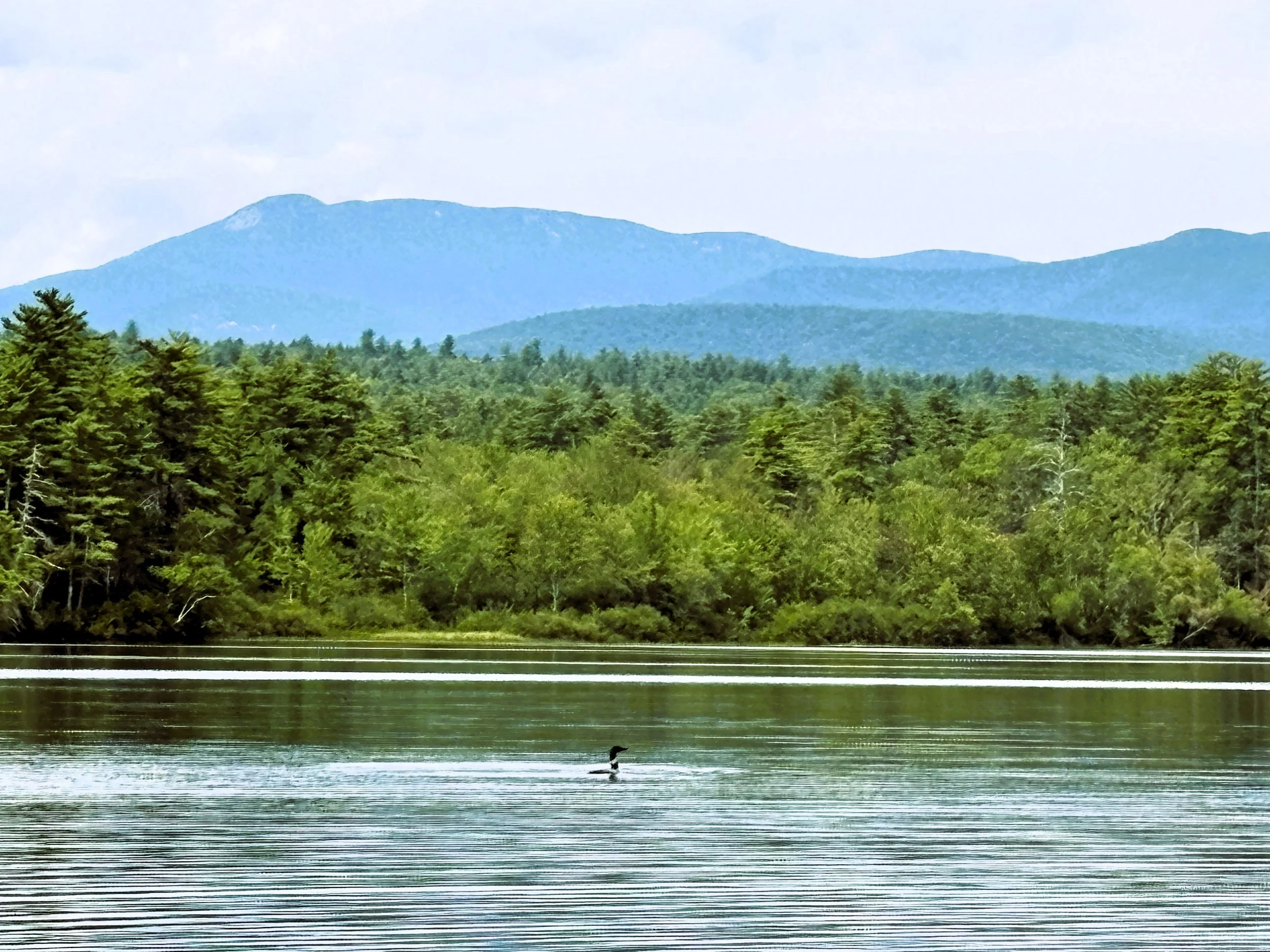
Banner Image: A serene loon on Chocorua Lake. Photo Credits: Anna Paddock